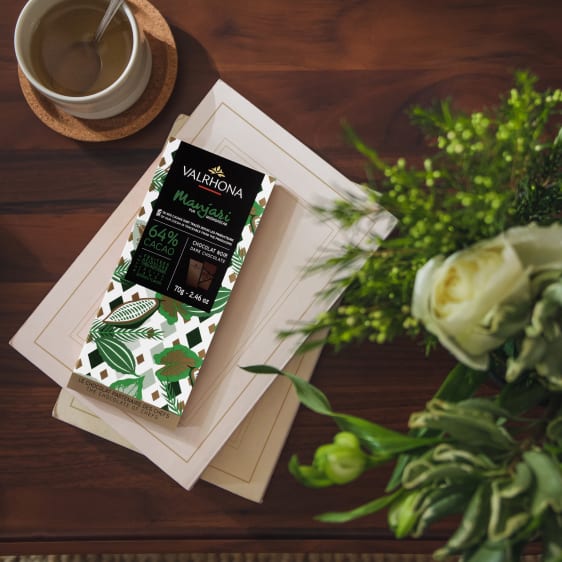
Manjari 64% Named Top Chocolate Bar in The New York Times
Manjari Named the Top Chocolate Bar in The New York Times’ “How to Be Cultured” Edition
Some recognitions resonate far beyond a ranking. They affirm a product’s place not only in the market, but in the minds and hands of the professionals who shape taste.
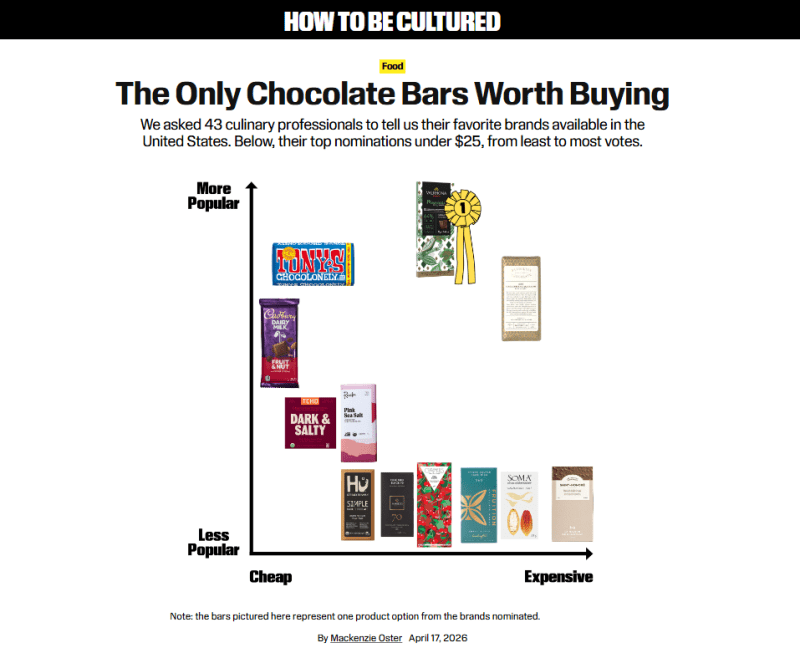
We are proud to share that Manjari 64% was named the top choice in a recent New York Times feature, “The Only Chocolate Bars Worth Buying,” published as part of its How to Be Cultured series. In the piece, 43 culinary professionals were asked to name their favorite chocolate bars available in the United States for under $25. Manjari took the number-one spot, with 10 votes, ahead of a field of highly respected international brands.
For Valrhona, this is more than a proud headline. It is a meaningful signal from the culinary world that one of our most iconic chocolates continues to stand apart for its flavor, identity, and versatility.
What Is "How to Be Cultured"?
The New York Times’ How to Be Cultured is a curated editorial series designed to help readers navigate taste, quality, and contemporary culture across categories, from food and wine to design and lifestyle. In this edition, the focus was chocolate: specifically, the bars worth buying in the U.S. market today. The article framed its selection clearly, asking 43 culinary professionals to identify their favorite bars available in the United States, then ranking the top nominations under $25 from least to most votes.
That framing matters. This was not a single-editor pick or a trend roundup. It was a collective snapshot of professional preference, an industry-informed view of what stands out in a crowded market.
How Manjari Was Selected
The selection process itself is part of what gives this recognition its weight. The panel included an impressive cross-section of chefs, pastry chefs, bakers, cookbook authors, restaurateurs, entrepreneurs, and chocolate specialists; including Dominique Ansel, Eunji Lee, Orlando Soto, and Christina Wood, some chefs from our Cercle V program, as well as Nancy Silverton, Monica Glass, Valerie Gordon, E.J. Lagasse, Camari Mick, Natasha Pickowicz, Caroline Schiff, and Shilpa Uskokovic, among others.
In that context, Manjari’s placement at the top is especially meaningful. It reflects recognition from professionals whose standards are shaped by technique, sourcing, flavor precision, and real-world use.
The article’s featured quote on Manjari described it simply and effectively: “Smooth, with balanced acidity.” That concise assessment gets to the heart of what has made Manjari a benchmark chocolate for decades.
Why Manjari Continues to Stand Apart

Created in 1990, Manjari was developed after Valrhona’s sourcing teams discovered remarkable cocoa beans in Madagascar and chose to showcase their uniquely expressive profile through a dedicated single-origin couverture. Since then, it has become one of the brand’s true iconics. Even its name carries a layered identity, drawing from both the Madagascan word for “good” and a Hindustani word meaning “bouquet.”
Manjari 64% is often described internally as Valrhona’s instantly recognizable, number-one tangy chocolate, and that distinction is rooted in its sensory profile. Its major characteristic is fruity, its minor note is tangy, and its exceptional note is berries. The result is a couverture with fleshy red-fruit notes and vivid brightness, one that feels unmistakably alive on the palate.
That profile helps explain why Manjari continues to appeal to chefs. It offers intensity without heaviness, acidity without sharpness, and a fruit-driven aromatic profile that creates both contrast and lift in plated desserts, molded applications, bars, mousses, crémeux, ganaches, ice creams, and sorbets.
Its natural pairings also speak to its creative range: blackcurrant, raspberry, morello cherry, Szechuan pepper, and muscovado sugar all complement its profile beautifully.
A Signature Chocolate, Rooted in Madagascar
Part of what gives Manjari its depth is the long-term relationship behind it.
Manjari comes from Valrhona’s longstanding partnership with the Millot plantation in northern Madagascar. The relationship began in 1986, and in 2016, Valrhona became a shareholder in Société Millot, reinforcing a shared long-term development strategy. Today, Valrhona holds exclusive purchasing rights over all cocoa grown on the organic-certified Millot plantation, as well as cocoa grown by a network of local producers.
Millot itself is a historic plantation founded in 1906 in Andzavibe, near Ambanja. Société Millot manages nearly 3300 acres and employs almost 500 people. The partnership has also been accompanied by long-term social and environmental initiatives, including the renovation of a village for employees and their families, the construction of a primary healthcare center, the planting of 151,400 cocoa trees within agroforestry systems along with 5,000 shade trees, and 2,468 medical consultations delivered in 2022 alone.
The carbon work is also notable: the Millot cocoa supply chain was measured at 0.57 kg of CO2 per kilo of cocoa, compared with an average of 23 kg CO2 per kilo for all cocoa.
This is one of the reasons Manjari resonates so strongly today. It is not only a chocolate with a distinctive flavor profile; it is also the result of a long-term sourcing relationship built around quality, continuity, and impact.
Why Chefs Choose Valrhona
This recognition also opens a broader conversation: why do chefs continue to choose Valrhona?
The answer begins with flavor, of course, but it does not end there.
For professionals, a chocolate must do more than taste good in isolation. It must behave consistently, translate its aromatic profile clearly in application, and offer enough identity to support a chef’s point of view. Manjari delivers on all three. Its acidity is balanced, its fruit notes remain expressive in formulation, and its technical versatility makes it equally relevant in bars, entremets, plated desserts, frozen applications, and confectionery.
That balance of sensory precision and technical reliability is exactly why chefs return to Valrhona again and again. A couverture like Manjari is not simply an ingredient; it is a creative tool.
Inspiration from the Cercle V Community
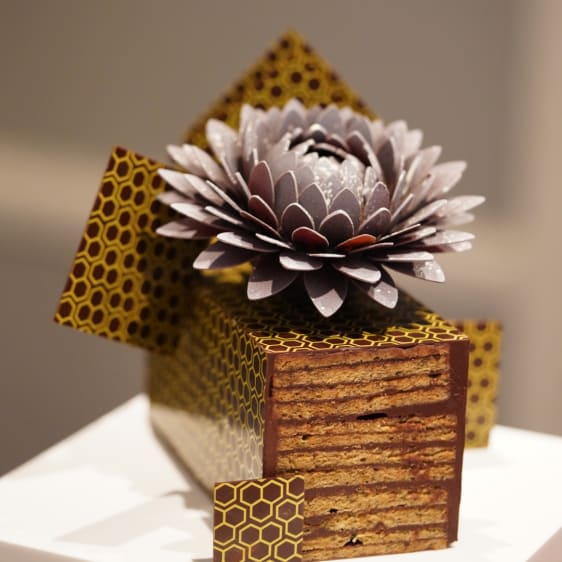
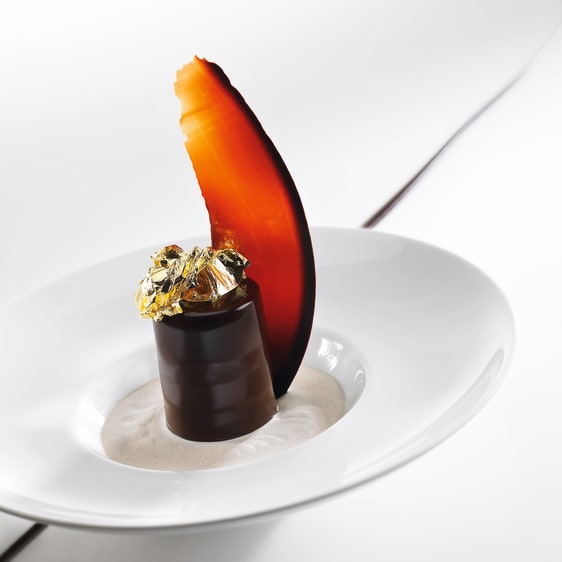
For professionals looking to explore Manjari 64% in plated desserts and pastry applications, our Cercle V community offers beautiful examples of how this chocolate can be interpreted through different styles and formats.
You can discover Manjari in these three recipes:
These creations show exactly what makes Manjari so compelling in the kitchen: its ability to bring fruit, freshness, length, and definition to a wide range of dessert concepts.
A Meaningful Recognition for an Iconic Chocolate
For many professionals, Manjari is not a new discovery. It is a trusted iconic. But this latest recognition from The New York Times confirms something important: even in a fast-moving market, true icons endure for a reason.
Manjari continues to stand out because it offers something increasingly rare, a clear identity. It tastes of origin. It performs across applications. It inspires chefs. And it reminds us that a great chocolate bar can still be both deeply personal and widely admired.
For Valrhona, this top ranking is a proud moment.
For chefs, it is another reason to keep reaching for one of the most distinctive chocolates in the category.