From Producer to Artisan: A 100% Traceable, Fair-Trade Cocoa
Chocolate is one of those universal pleasures that transcends ages and cultures. Yet, behind every cocoa bean lies an industry undergoing significant change. Threatened by climate change, extreme poverty among producers, and unsustainable farming practices, cocoa is becoming scarce, its price is soaring, and its quality is becoming uncertain. In response to the growing complexity of the industry, Maison Valrhona is taking action to create an exceptional cocoa supply chain by working closely with its partner producers for more equitable chocolate and promoting the resilience of agricultural systems.

Fighting Deforestation to Preserve Tomorrow's Cocoa
Deforestation is the leading cause of CO2 emissions in the cocoa industry. In response to this urgent issue, the European Union Deforestation Regulation (EUDR) "aims to prohibit the placing on the market or export from the European market of products that have contributed to deforestation or forest degradation after December 31, 2020."
To ensure the sustainability of the cocoa industry, Valrhona works tirelessly every day to exceed standards. Because exceptional chocolate is born from the best conditions. This ambition is reflected in concrete and measurable actions, structured around three key areas :
1- We Precisely Trace Our Plots and Ensure They Are Not Located in Protected Areas
In 2024, 100% of the plots of our cocoa partners were traced, regardless of their size, compared to the 4 hectares required by law. To achieve this, all plots of our partner producers, regardless of their size, were mapped using polygons: a series of GPS points that outline the edges of each plot. These polygons are then positioned on the official maps of each country—an essential step that allows us to verify that the plots are not located in protected areas. This meticulous work is crucial for creating a fair and sustainable supply chain because it enables us to know where our cocoa comes from, who produced it, and under what conditions, while also ensuring that none of our cocoa beans come from protected areas.
2- We Analyze the Risk of Deforestation Over a 20-Year Period vs. 5 Years Required by Law
Mapping allows us to measure changes in tree cover using satellite images. For this, the GPS coordinates of our producers' plots are cross-referenced with the historical forest cover maps from the last 20 years (compared to the 5 years required by law) to ensure that our cocoa has not contributed to deforestation.
This analysis of forest cover loss over 20 years enables us to precisely refine the carbon footprint calculation for each of our cocoa varieties. In 2023, we launched a program with the NGO Nitidae to calculate the exact carbon footprint of each cocoa plot. The goal of this program is to determine the carbon impact of each kilogram of cocoa we purchase and to identify carbon emission reduction actions tailored to each origin. All this precise work is made possible thanks to the long-term partnerships we maintain with our cocoa producers (8.5 years on average).
3- We Place Agroecology at the Heart of Our Actions
60% of our partners are already engaged in agroecological practices that diversify crops, promote biodiversity, and improve producers' incomes. Because this issue is crucial for preserving cocoa cultivation in the long term, we are committed to deploying agroecological practices with 100% of our partners by 2030, to ensure the sustainability of crops and the well-being of communities. This approach is region-specific: it is always adapted to the realities on the ground and the maturity of production methods. Since 2018, four major projects with our partners have been implemented:
• The Cacao Forest project in the Dominican Republic and then in Côte d'Ivoire
• The Creole garden regeneration project in Haiti
• The TRACTIONS project and the collaborative learning center project in Indonesia
Our support helps recreate biodiversity and increase producers' incomes from 400 USD per hectare per year to 1000 to 3000 USD depending on the models.
Through the testimony of Nans Mouret, Valrhona cocoa sourcer, and Thomas Fabre from Nitidae, discover the actions taken by Valrhona to calculate our carbon footprint on the ground.
Towards 100% Fair Trade Cocoa by 2030
Because shaping the future of chocolate also means preserving the future of the men and women who cultivate it, we have taken a decisive step towards a more equitable cocoa supply chain. We have chosen to certify what we have always done: supporting our cocoa producers.
In 2025, 30% of our cocoa bean purchases are now certified according to internationally recognized standards, such as Fairtrade Maxhavelaar and Fair for Life (compared to 3% in 2023). This is a significant advancement, with a clear trajectory: to achieve 100% fair trade certified beans by 2030.

A Long-Term Approach with Concrete Effects
This evolution allows us to support the organizations of our partner producers today, while meeting the growing expectations of our professional and individual clients: the ability to source exceptional chocolate that is traceable and socially and environmentally respectful.
This approach is part of a continuous effort, as at Valrhona, we continue our historical partnerships—some of which have lasted for over 30 years—while supporting them in their transition towards certification. Contracts are concluded for a minimum duration of 3 years, with a current average of 8.5 years, demonstrating a commitment to long-term engagement.
The projects we undertake together are founded on the following main pillars:
- Decent living and working conditions
- Environmental preservation
- Valuation of expertise
- Innovative agroecological practices
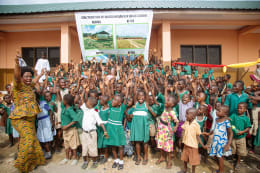
Certification allows us to achieve several things: financing our purchases from producers, establishing long-term partnerships, and also providing significant premiums that we reinvest in communities. This includes building schools, water towers to improve access to drinking water, and developing income-generating activities for women to promote their empowerment.
States Aminata Bamba, Sustainability Manager, ECOOKIM

The Côte d’Ivoire Organic 56% Sourceur's Cuvée: A Concrete Illustration
This Côte d’Ivoire Pure Origin Sourceur's Cuvée, certified Organic Agriculture—with beans purchased according to fair trade principles—fully embodies this commitment.
Produced from beans cultivated, fermented, and dried in the heart of the world's leading cocoa-producing country, it reflects the values upheld by Maison Valrhona and its Fairtrade-certified partner cooperative, with which it has collaborated for over 10 years. This long-term partnership, founded on mutual trust, has enabled the experimentation and structuring of a large-scale fair and organic supply chain in Côte d’Ivoire. This creation expresses the full potential of exceptional cocoa, cultivated with respect for ecosystems and local communities.
Agroecology is "the use of nature's resources and mechanisms for agricultural production. It combines ecological, economic, and social dimensions and aims to better leverage interactions between plants, animals, humans, and the environment."

Towards a More Responsible and Sustainable Supply Chain
By relying on advanced traceability (far beyond EUDR regulations), as well as the principles of fair trade and agroecology, Valrhona is committed to building a more responsible and sustainable cocoa supply chain. These concrete actions contribute to combating deforestation and preserving forests, ensuring fairer compensation and living conditions for producers, and implementing environmentally respectful agricultural practices. Through close collaboration with our partner producers, we continue to innovate and invest in sustainable solutions to shape the future of cocoa.
Convinced that the future of chocolate is closely linked to that of living beings, we pursue a collective and sincere action alongside our producers, artisans, and chef partners, to reveal the richness of exceptional chocolate and create unforgettable sensory emotions, while respecting those who cultivate it.