Cacao & Cardamom: Annie Rupani’s Edible Storytelling, from the World to Houston
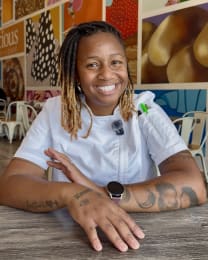
During a recent trip to Houston, our team had the pleasure of meeting another member of our Cercle V community: Cacao & Cardamom, the award-winning chocolate atelier founded by chocolatier Annie Rupani.

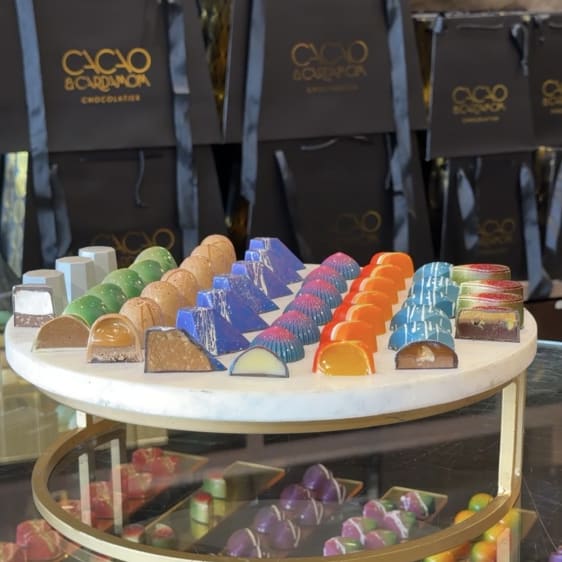
Located in Houston’s Galleria area, Cacao & Cardamom has built a distinctive voice in American fine chocolate: one shaped by artistry, travel, memory, and spice. Annie’s bonbons are instantly recognizable not only for their visual sophistication, but for the stories they tell: stories rooted in her South Asian heritage, her global culinary influences, and her desire to expand what chocolate can express.
But behind that creative vision is another story too: one of a founder building a business while also raising a young family, navigating growth with intention, and redefining what success can look like in different seasons of life.
A Chocolate Language Shaped by Heritage
For Annie, flavor begins with memory.
Raised in a Pakistani household, she grew up surrounded by spices such as cardamom, cumin, coriander, and fennel, ingredients that were part of everyday life long before they became part of her chocolate world. In Houston, where there is a large Pakistani community, those flavors remained deeply embedded in her experience as a first-generation American.
“We were always all about food,” she says. “Pakistani food and spices and culture have been a huge part of my first-generation American experience.”
That foundation continues to shape the identity of Cacao & Cardamom today.
One example is her use of cashew, an ingredient she feels remains underrepresented in confectionery despite its richness and familiarity in South Asian households. “Cashews are not used as much in confections,” Annie explains. “I grew up with cashews and pistachios almost every day, so I wanted to do a cashew praliné because it’s not often that you see caramelized cashews ground into a beautiful paste.”
Her now-signature approach to flavor was also shaped by one of the first bonbons she created outside of more conventional European references: Cardamom Rose.
“Cardamom is a spice that is used in sweets a lot in South Asian culture,” she says. “And when my mom bit into that first bonbon, she said, ‘Oh, this tastes like mithai.’” That moment was catalytic. “If we can do mithai,” Annie recalls thinking, “why can’t we do things with cashew, or guava, or tamarind, or even Chinese spice?”
That question has become part of the brand’s DNA: using chocolate as a medium for cultural memory, reinterpretation, and discovery.
Building a World of Flavor
At Cacao & Cardamom, chocolate is more than confection, it is edible storytelling.

The brand’s collections draw inspiration from spices and ingredients from around the world, translating them into finely crafted bonbons that invite customers to see chocolate differently. Annie’s work has become known for flavor pairings that are both adventurous and deeply grounded: cardamom rose, garam masala pistachio, masala chai, falooda-inspired seasonal creations, and more.
Some of those stories are personal in the most literal sense. When she first launched Cacao & Cardamom, Annie’s mother would grind the spices for the Garam Masala Pistachio bonbon herself.
“We had a fresh homemade garam masala,” Annie says. “We got a little too big for that, but it’s still really fun to have that story.”
That tension, between intimacy and scale, craft and growth, is part of what makes the brand so compelling.
Today, the team produces approximately 15,000 to 20,000 bonbons per week, depending on the season, across roughly 30 year-round flavors, excluding seasonal collections. Yet even at that volume, the work remains deeply personal in both concept and execution.
Motherhood, Growth, and Choosing the Right Pace
What gives this story additional depth is the stage of life Annie is navigating as a founder.
Since COVID, Cacao & Cardamom has shifted to a business model that is approximately 70% online, a transition that has created more flexibility as she balances creative leadership with motherhood. Annie now spends much of her time on research and development: building collections, shaping flavor direction, and steering the brand, while also prioritizing time with her two young children, ages two and five.
“I do a lot of the R&D, so I love creating collections,” she says. “But in terms of everyday production, I’m rarely there anymore because I’m spending more time with the kids.”
That balance is intentional. “I want to make sure that they’re prioritized as well as running the business efficiently.”
The way Annie speaks about motherhood is deeply candid, and it reveals just how much emotional intelligence sits behind her leadership.
“You care for this being so much that you’re willing to do anything,” she says of motherhood. There is no performance in that sentiment. And perhaps that is part of what makes her work feel so resonant. The same woman building sophisticated collections inspired by travel, religion, and cultural memory is also building a life attentive to presence, care, and seasonality in the broadest sense.
Even her children already have favorite creations: her daughter loves Cardamom Rose, while her son is especially fond of Cashew Cinnamon.
Seasonal Collections as Cultural Expression
For Annie, seasonal collections are some of the most meaningful work she creates. Among them, Diwali has become one of the brand’s most important moments of the year, now its second biggest holiday. It is also one of the most personally fulfilling.
“Diwali is so associated with South Asian culture,” Annie says. “It’s such a fun collection for me because I get to do things that I grew up with and flavors that I would love to try.”
One recent example was a Falooda-inspired bonbon, based on the rose-forward drink often served at weddings, made with basil seeds and ice cream. “It was something I grew up with,” she says, “and everybody loved it. It’s so fulfilling in a way.”
That sense of fulfillment matters. It reflects a broader shift happening across pastry and chocolate, where authenticity and specificity are becoming increasingly valuable, not just commercially, but emotionally. Annie’s work shows that when artisans create from a place of cultural truth, the result can feel both singular and universal.
A Different Kind of Ambition
Annie’s story is also one of openness to an unexpected path.

Originally trained in Anthropology and Religion, she once imagined a future shaped by law school. Chocolate began almost as an interlude: something she explored while preparing for the LSAT. But what started as a break became a calling, leading her from Houston to Pakistan, then to pastry studies in Kuala Lumpur, and eventually back to chocolate with a clearer sense of purpose.
“I think being open to getting into chocolate and creating a path for myself in a direction that wasn’t law was something that the universe guided me to,” she says.
That path continues to evolve. While Annie has intentionally paused major retail expansion while her children are still very young, she already sees future possibilities ahead. Additional stores are very much part of the long-term vision, including the idea of expanding internationally.
“We were talking about opening a store in Toronto right before I got pregnant,” she says. “That’s still a possibility. I would love to be more of a nomadic family, so having stores in different parts of the world is definitely something I would love to do.”
It is ambition, but not acceleration for its own sake. It is growth imagined on human terms.
Chocolate as Legacy
When asked whether her children might one day take over the business, Annie smiles at the thought.
“It’s really fun to go to a business that has been in families for generations,” she says. “I do hope that it’s there in some form or fashion.”
Whether or not Cacao & Cardamom becomes a multigenerational family business, that idea of transmission already runs through Annie’s work: family recipes, spices from childhood, inherited rituals, cultural memory translated into contemporary chocolate. Her daughter, she notes, is already very artistic. And whether or not the children eventually choose chocolate, Annie hopes the business will shape them in some way.
“Entrepreneurship can teach you so much about life and humans,” she says. “I would love for them to have an experience here that did translate into their lives.”
That may be one of the most beautiful truths at the center of Cacao & Cardamom: that chocolate can be both a craft and a language, both a business and an inheritance.
Follow our visit to Cacao & Cardamom on Instagram @valrhonaUSA to discover how Annie's personal experiences influences her craft.
Are you a professional working with Valrhona chocolate and proud to be part of our community? Tag us @valrhonaUSA for a chance to be featured.